
 A Guide to Our Nation’s Founding Document
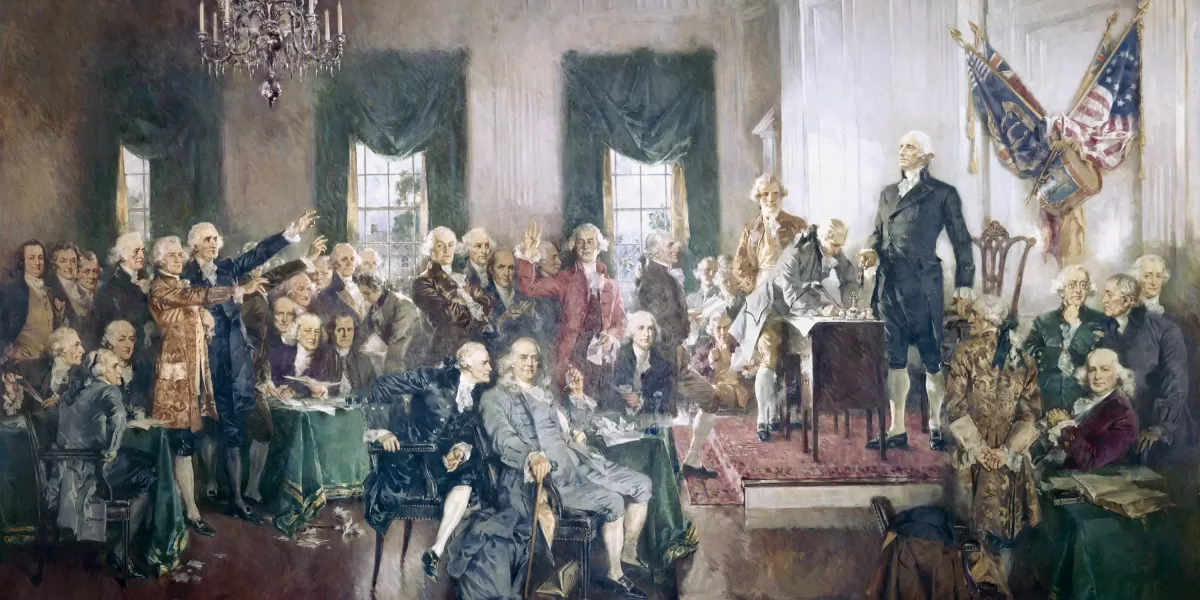
The United States Constitution is one of the most important documents in American history. Written in 1787 and ratified in 1788, it created the framework for our government and set out the principles of freedom and justice that still guide us today.
When the country declared independence in 1776, the Founding Fathers knew they would need a strong plan to hold the new nation together. The Constitution became that plan. It begins with the Preamble, a short introduction that explains the goals of the government:
“We the People of the United States, in Order to form a more perfect Union, establish Justice, insure domestic Tranquility, provide for the common defence, promote the general Welfare, and secure the Blessings of Liberty to ourselves and our Posterity, do ordain and establish this Constitution for the United States of America.”
The Constitution is divided into seven articles and has been amended 27 times. It established a government with three branches — legislative, executive, and judicial — and created a system of checks and balances so no one branch could become too powerful.
It also protects the rights of citizens through the Bill of Rights, the first ten amendments.
Key Facts about the Constitution
-
Created: September 17, 1787
-
Ratified: June 21, 1788
-
Became effective: March 4, 1789
-
System: Constitutional Republic
-
Branches of Government: 3
-
Articles: 7
-
Amendments: 27
-
Last Amendment: May 5, 1992
-
Location today: National Archives, Washington, D.C.
-
Signers: 39 delegates from the Philadelphia Convention
Vocabulary to Know
Students should research and write definitions for these important terms:
Amendment, Article, Balance of Powers, Bill of Rights, Citizenship, Delegate, Electoral College, Enumeration, Executive Branch, Federalism, Filibuster, Founding Fathers, Equality, Judicial Branch, Legislative Branch, Liberty, Nation, Ratification, Republic, Rights, Separation of Powers, Sovereignty, Tax, Tyranny, Unconstitutional, Union.
Videos to Watch
Schoolhouse Rock – The Preamble
Bill of Rights for Kids
Three Branches of Government
Checks and Balances Explained
27 Amendments Walkthrough
Activities for Students
1. The Preamble in Your Own Words
Rewrite the Preamble in kid-friendly language. Example:
“We the People” = Everyone in the United States.
“Establish Justice” = Make fair rules and courts.
2. Constitution Notebook Task
-
Copy the Preamble neatly into your notebook.
-
Underline three words you think are most important.
-
Write one sentence about why those words matter.
3. Bill of Rights Match-Up
Match each amendment (1–10) to what it protects. Example:
-
1st Amendment = Freedom of Speech, Religion, and Press.
(Teacher/parent can make this into flashcards or a worksheet.)
4. Three Branches Diagram
Draw a triangle and label each corner: Legislative, Executive, Judicial.
Write or draw one responsibility of each branch inside.
5. Create Your Own Amendment
If you could add one amendment today, what would it be?
Write it down and explain why it’s important.
Reflection Questions
-
Why did the Founding Fathers create three branches of government?
-
What rights are most important to you in the Bill of Rights?
-
How does the Constitution affect your daily life?
-
Why do you think it is important to study the Constitution today?